
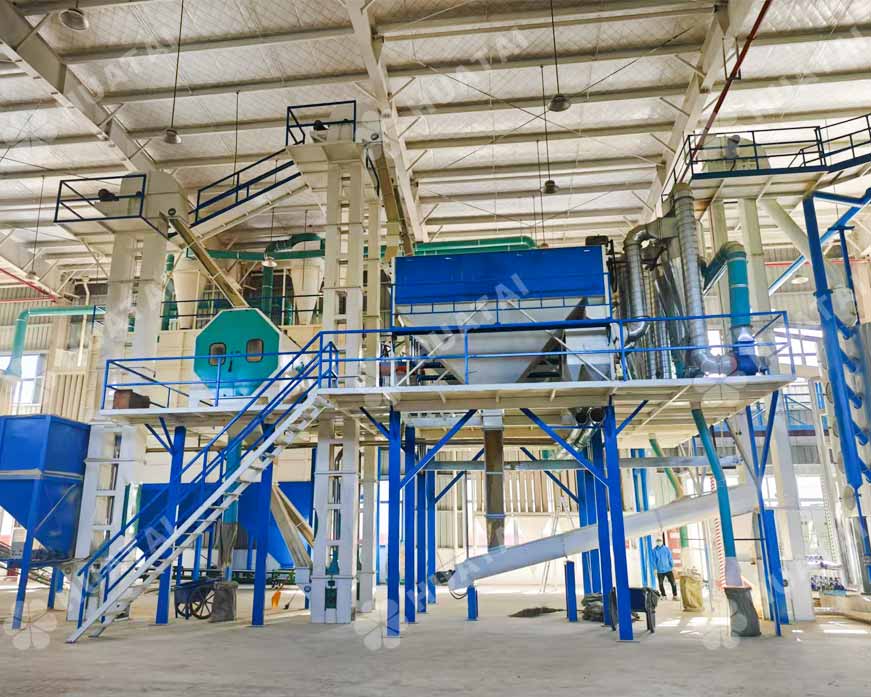
As a healthy cooking oil rich in gamma-oryzanol, vitamin E, and phytosterols, rice bran oil is increasingly favored by consumers. With the growing emphasis on healthy diets, the rice bran oil processing industry faces promising market prospects. So, how does one establish a modern rice bran oil mill? This article provides a comprehensive guide—covering market research, site selection and planning, process selection, equipment configuration, and operational launch—while drawing on the professional expertise of Henan Huatai Cereals & Oils Machinery Co., Ltd. to help you avoid common pitfalls.
Market Prospects and Feasibility Analysis
Conducting thorough market research and a feasibility analysis is the first step before officially establishing a plant. Rice bran is a byproduct of rice milling. However, the utilization rate for rice bran oil remains low, with vast quantities of rice bran left undeveloped; this presents a massive raw material base and significant market potential for the industry.
In terms of return on investment, rice bran oil processing projects offer strong economic benefits. Taking a medium-sized rice bran oil mill as an example, byproducts such as defatted rice bran meal (with a protein content exceeding 16%) can be sold to feed mills, generating an additional 15%–20% in revenue for the enterprise. A facility with a processing capacity of 100 tons per day can typically break even within three years. Naturally, the specific scale of investment should be determined based on factors such as production capacity targets and product grades (e.g., Grade III or Grade I oil).
Plant Site Selection and Raw Material Supply
Site selection is one of the most critical decisions in the plant establishment process.
1) Proximity to raw material sources. Rice bran is an oil-bearing material highly prone to rancidity; if fresh rice bran is not processed promptly after milling, its quality deteriorates rapidly. Therefore, the rice bran oil processing plant should be located as close as possible to rice mills or rice processing hubs to ensure the bran is processed within 24 hours. If the company operates its own rice mill, it can directly collect the bran as raw material; otherwise, it must establish stable procurement partnerships with nearby rice mills.
2) Scale requirements. Rice bran has an oil content of approximately 13%–15%, classifying it as a low-oil-content material. To ensure economic viability, it is generally recommended that the plant have a processing capacity of at least 20 tons of rice bran per day. The greater the daily processing capacity, the more pronounced the economies of scale and the lower the unit cost.
3) Infrastructure: The plant requires a stable power supply, an adequate water supply, and compliant solvent storage facilities. Furthermore, the factory buildings and workshops should be organized logically according to the process flow and meet relevant regulatory standards.
Core Processing Technology and Equipment Configuration
Rice bran oil production typically involves three main stages: pretreatment, solvent extraction, and refining/dewaxing.
1) Pretreatment Section
Due to the low oil content of rice bran and the tendency of its powdery material to clog equipment, direct pressing is not economically viable. Modern rice bran oil processing generally employs an “expansion pretreatment + solvent extraction” process route.
The pretreatment process typically includes: magnetic separation → vibrating screening → conditioning → extrusion expansion → drying. Extrusion expansion is the core step; high-temperature, high-pressure treatment causes rice bran particles to expand and increases porosity, inactivating the lipase enzymes that cause rancidity while significantly enhancing the efficiency of subsequent solvent extraction.
Huatai Oil Machinery possesses extensive technical expertise in the field of rice bran expansion pretreatment. In August 2024, the company successfully shipped a 100 TPD rice bran expansion and extraction project designed and manufactured for a client in Wuchang City, Heilongjiang Province. This project integrates rice bran pretreatment, expansion, extraction, and downstream processing, aiming to efficiently extract oil from the rice bran.
2) Solvent Extraction Section
Solvent extraction is the core stage of rice bran oil production. Organic solvents (typically No. 6 solvent oil) are used to dissolve and extract the oil from the rice bran, followed by separation of the oil from the solvent via evaporation and stripping. The advantage of the rice bran oil solvent extraction method is that the residual oil rate can be controlled below 1%—far lower than that of the pressing method—thereby maximizing oil yield.
Key equipment in the rice bran oil extraction section includes: oil extractors, evaporation units, stripping towers, condensers, and solvent recovery systems.
Huatai Oil Machinery possesses extensive experience with international projects in this field. For instance, a 30-ton-per-day (TPD) rice bran oil solvent extraction line customized for an Iranian client utilized an advanced drag-chain extractor combined with Huatai’s energy-saving process technologies; this effectively reduced consumption metrics and significantly improved product quality. The project exemplifies Huatai Oil Machinery’s capability to tailor designs to the client’s specific local production environment.
3) Refining and Dewaxing Section
Crude rice bran oil obtained through solvent extraction contains free fatty acids, waxes, colloidal impurities, and residual solvents; it must undergo refining to become marketable edible oil.
The typical rice bran oil refining process involves: degumming → deacidification → bleaching → deodorization → dewaxing. Dewaxing is a distinctive step in rice bran oil refining; because the oil contains high-melting-point waxes, failure to remove them would cause the finished oil to become cloudy at low temperatures.
Huatai Oil Machinery’s complete equipment solutions for refining Grade-1 rice bran oil successfully address issues related to the rapid deterioration and rancidity of rice bran, enabling high-value utilization of the oil.
Why Choose Huatai Oil Machinery—The Value of a Professional Partner
Establishing a rice bran oil mill is a complex undertaking, making the choice of an experienced equipment supplier with robust technical expertise crucial. Henan Huatai Cereals & Oils Machinery Co., Ltd. stands out in this regard due to several key strengths:
1) Deep Industry Expertise. Established in 1988, Huatai Oil Machinery boasts over 38 years of experience in manufacturing oil and fat processing equipment. Covering an area of 100,000 square meters and featuring 12 modern, intelligent manufacturing workshops, the company is recognized as a National High-Tech Enterprise, a National Green Factory, and a key “Little Giant” enterprise (specializing in niche markets with cutting-edge technologies).
2) Leading Technical Capabilities. Huatai Machinery holds numerous national invention patents, including those for Grade-1 rice bran oil refining, protein extraction and separation from rice bran, and oryzanol extraction. The company also possesses patented technologies such as the molecular distillation method for refining Grade-1 rice bran oil. Its complete sets of oil processing machinery have been exported to over 70 countries and regions worldwide.
3) Comprehensive Service System. Huatai Oil Machinery provides “turnkey” services, covering everything from design, manufacturing, and installation/commissioning to staff training. With offices established in more than 20 countries and regions globally, the company ensures that clients receive timely and professional technical support. Extensive project portfolio. From a 100 TPD (tons per day) rice bran oil expansion and solvent extraction project in Heilongjiang Province and a 24 TPD rice bran oil refining and dewaxing project in Jiangsu Province to a 30 TPD rice bran oil extraction line in Iran, Huatai Oil Machinery has accumulated a wealth of experience across projects of varying scales and locations in the rice bran oil processing sector.
Recommendations for Plant Implementation
Step 1: Define project scope. Determine the target processing capacity (e.g., 30, 50, or 100 tons of rice bran per day) and the finished oil grade (Grade III or Grade I); these factors directly dictate the process route and equipment configuration.
Step 2: Complete feasibility studies and approvals. Prepare a project feasibility study report and complete necessary administrative procedures, such as project filing, environmental impact assessments (EIA), and safety assessments.
Step 3: Site selection and plant layout planning. Select a site based on raw material supply proximity and infrastructure conditions, and design a scientifically optimized plant layout.
Step 4: Equipment selection and procurement. Choose a rice bran oil equipment supplier with proven technical expertise and project experience—such as Huatai Oil Machinery—to ensure equipment quality, advanced processing technology, and reliable after-sales service.
Step 5: Engineering construction, installation, and commissioning. Complete civil engineering works, equipment installation, piping connections, and the commissioning of automation control systems.
Step 6: Personnel training and trial production. Conduct systematic training for operators, carry out trial runs and product testing, and commence formal production once all performance indicators meet standards.
Setting up a rice bran oil mill requires a comprehensive assessment of factors such as raw material supply, processing technology, equipment selection, and return on investment. Partnering with an experienced company that offers advanced technology and comprehensive services—such as Henan Huatai Cereals & Oils Machinery Co., Ltd.—will significantly reduce project risks and enhance investment returns. If you require a complete rice bran oil processing line, please contact us for a tailored solution.
Website: https://ricebranoilpress.com/
Email: info06@cnoilmachine.com