
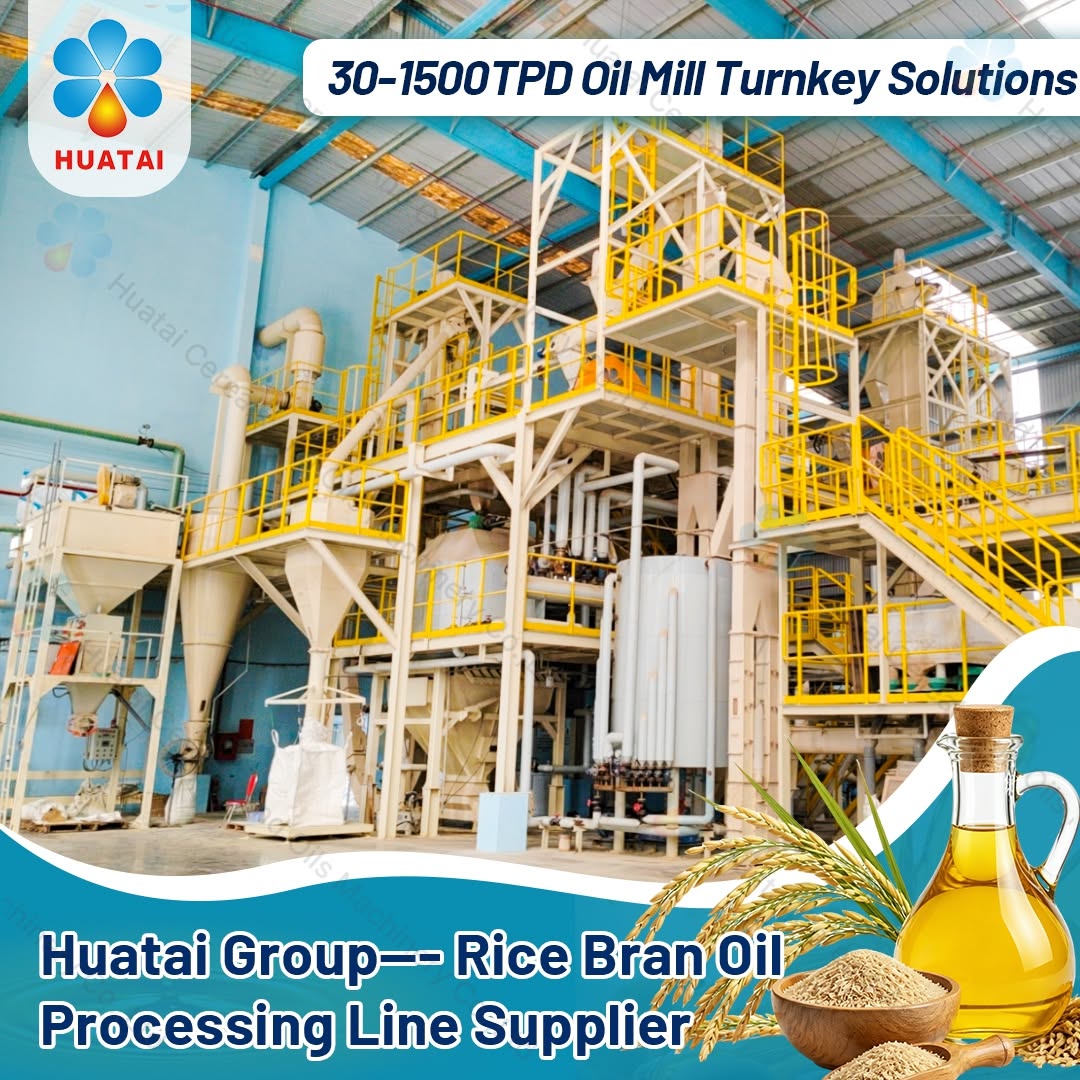
Rice bran oil is hailed as “liquid gold” derived from rice; it boasts an unsaturated fatty acid content of 60%–70% and is rich in bioactive components such as gamma-oryzanol, phytosterols, and Vitamin E. However, the presence of active lipase in rice bran causes the acid value of the crude oil to rise rapidly. Furthermore, because rice bran exists as a powder containing broken rice and germ, solvent penetration is difficult during direct solvent extraction. These characteristics dictate that rice bran oil production requires specific process routes and equipment configurations.
As a leading enterprise in China’s grain and oil machinery sector, Henan Huatai Cereals & Oils Machinery Co., Ltd. has completed over 1,000 projects and exported products to more than 70 countries since its establishment in 1988, accumulating 38 years of technical experience in complete rice bran oil equipment systems. This article outlines the core process stages of rice bran oil production, highlighting the features of Huatai’s equipment.
Rice Bran Pre-treatment Section: Stabilization and Expansion
Rice bran pre-treatment is the foundational step that determines subsequent extraction efficiency and crude oil quality. Fresh rice bran is highly prone to rancidity after milling and requires timely stabilization.
1) Bran and rice separation is the first critical step in pre-treatment. Rice bran contains 5%–15% broken rice and germ; if these are not removed, solvent consumption increases, oil yield drops, and the compactness of subsequent expansion is compromised. Huatai’s improved equipment employs a three-stage separation structure, keeping the broken rice content in the bran and the bran content in the broken rice both below 1%, while also significantly increasing processing capacity.
2) Expansion (extrusion) is a crucial prerequisite for rice bran solvent extraction. Solvents cannot penetrate powdered rice bran effectively during direct extraction, so the material must first undergo expansion. Huatai showcased an advanced expander featuring automated hydraulic control at a recent international rice bran oil conference; this system improves granule structural stability through effective lipase deactivation and automatic hydraulic adjustment of the discharge mechanism.
Rice Bran Oil Extraction Section: Solvent Extraction and Mixed Oil Evaporation
Solvent extraction is currently the mainstream process for rice bran oil processing line; it utilizes organic solvents to dissolve and extract the oil, followed by solvent recovery through evaporation and stripping.
1) The extractor is the core piece of equipment. Rice bran particles come into contact with the solvent in a counter-current flow within the extractor, allowing the oil to be extracted into the solvent mixture (known as “mixed oil”). Huatai offers equipment such as rotocel extractors, paired with complete rice bran oil processing solutions designed for materials with high fines content, to accommodate the specific characteristics of rice bran. The extraction temperature is typically maintained at around 55°C to ensure extraction efficiency while preventing oil quality degradation caused by excessive heat.
2) The evaporation and stripping of the mixed oil serve the dual purpose of solvent recovery and crude oil concentration. Employing a vacuum evaporation process lowers the evaporation temperature, thereby minimizing thermal damage to the oil. Equipment design and parameter control during this stage directly impact solvent consumption and crude oil quality.
Rice Bran Oil Refining Section: From Crude Oil to Finished Product
Crude rice bran oil contains free fatty acids, waxes, colloidal impurities, and residual solvents; it must undergo refining to meet edible standards. The challenges in refining rice bran oil lie in the crude oil’s high acid value, wax content (2%–5%), and dark color, which makes decolorization difficult.
1) Degumming marks the beginning of the rice bran oil refining process. The presence of colloidal impurities in crude rice bran oil not only affects oil quality but also leads to coking and the formation of deposits on equipment surfaces at high temperatures. Huatai’s degumming method involves a reaction with phosphoric acid, followed by filtration using spent bleaching earth to remove residual phospholipids and metal ions.
2) Dewaxing is particularly critical for rice bran oil. Waxes in the crude oil can compromise the transparency of the finished product and affect performance in cold stability tests. The process typically involves cooling the oil to below 15°C, allowing for slow crystallization with agitation in a crystallization tank, and subsequently separating the wax via filtration. Huatai positions the dewaxing stage early in the refining sequence—after degumming and drying but before decolorization—a layout that promotes stable operation in subsequent stages.
3) Deacidification is the stage associated with the highest oil loss during rice bran oil refining. While the traditional alkali refining method removes free fatty acids, it also causes the saponification of neutral oil; the higher the acid value of the rice bran oil, the greater the loss. Furthermore, the resulting soapstock and wastewater are difficult to treat. Physical refining (distillation deacidification) separates free fatty acids from triglycerides based on differences in volatility under vacuum conditions, thereby avoiding the chemical losses associated with alkali refining. In Huatai’s rice bran oil refining solutions, the physical deacidification and alkali refining stages can be flexibly configured according to customer requirements, balancing yield with the quality of the finished product.
3) Bleaching and deodorization are the final stages that determine the appearance and flavor of the finished oil. Bleaching is typically performed under vacuum; an optimal dosage of bleaching earth is approximately 2% of the oil mass, with a bleaching temperature of 110°C and a duration of 30 minutes. Deodorization utilizes a high-vacuum packed tower, with direct steam consumption at about 1% of the oil mass and absolute pressure maintained below 200 Pa. Huatai’s deodorization process focuses on maximizing the retention of nutrients such as gamma-oryzanol while minimizing the formation of harmful substances like trans fatty acids and 3-MCPD.
Technical Features of Huatai Rice Bran Oil Equipment
From the perspective of an equipment supplier, Huatai’s expertise in rice bran oil production equipment is evident across several dimensions:
1) Comprehensive industry chain coverage. Huatai provides complete equipment sets covering everything from pretreatment and solvent extraction to refining. For a rice bran oil production line project in Vietnam, Huatai managed the entire process—including process design, manufacturing, intelligent control systems, and installation. Its equipment sets handle processing capacities ranging from 30 to 1,200 tons per day, with processes customizable to specific oil types and client needs.
2) Targeted design for the pretreatment stage. Addressing the characteristic presence of broken rice and germ in rice bran, Huatai’s oil production solutions are specifically adapted for materials with high fines content. The conditioning cooker features an innovative permeable layer design, utilizing a combination of indirect and direct steam to achieve more efficient and energy-saving softening results.
3) Extension into deep processing of by-products. The value of rice bran oil processing extends beyond the finished oil itself. Huatai has mastered deep processing technologies for by-products such as refined rice bran wax, gamma-oryzanol, and ferulic acid, thereby transforming rice bran oil processing from simple oil production into a comprehensive value-chain enhancement. This capability is crucial for enhancing the overall economic efficiency of the rice bran oil plant.
3) Energy-saving and eco-friendly design. The Huatai rice bran oil refining process emphasizes waste heat recovery and reduced steam consumption; vacuum systems utilize chilled-water or freeze-vacuum solutions to minimize steam usage and wastewater discharge; and the bleaching earth cake-blowing stage is equipped with odor-capture devices to meet environmental standards.
Conclusion
The core processes of rice bran oil production equipment can be summarized into three main lines: pretreatment (bran and rice separation and expansion), extraction (solvent extraction, evaporation, and stripping), and refining (degumming, dewaxing, deacidification, bleaching, and deodorization). Each stage presents specific technical challenges and operational parameter ranges; consequently, rice bran oil equipment configuration and process design must be tailored to the characteristics of the rice bran raw material, the target positioning of the finished oil, and the scale of the plant. For enterprises planning to invest in rice bran oil production lines, selecting a supplier with comprehensive equipment capabilities and extensive process expertise often yields greater long-term value than simply comparing the prices of individual machines.
Website: https://ricebranoilpress.com/
Email: info06@cnoilmachine.com