
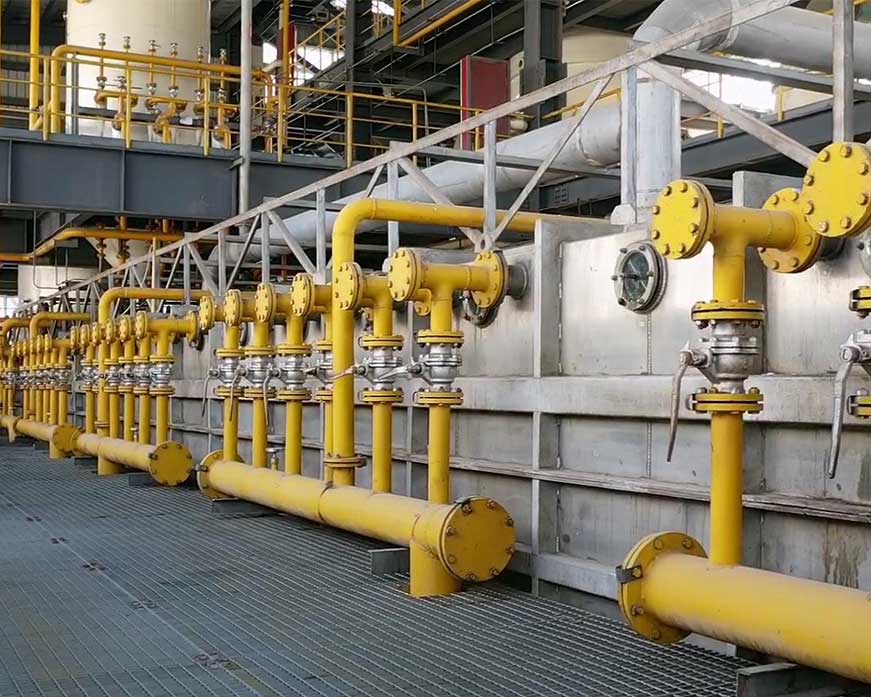
Rice bran is a byproduct of rice processing, typically containing between 10% and 23% oil. Due to its low oil content, powdery texture, and high susceptibility to rancidity, rice bran places demanding requirements on the solvent extraction process and equipment. Solvent extraction allows the residual oil content in the meal to be controlled at below 1%, a performance far superior to the 6%–7% residual oil levels associated with mechanical pressing. So, what exactly are the requirements for the feedstock used in rice bran oil solvent extraction machine? As a professional manufacturer with over 38 years of experience in the oils and fats machinery industry, Henan Huatai Cereals & Oils Machinery Co., Ltd. offers a detailed explanation based on its extensive project experience.
Pre-treatment Stage: Removing Impurities is the First Step
Before entering the solvent extraction system, rice bran must undergo a rigorous cleaning process. It is often contaminated with hard impurities such as iron particles and grit, as well as broken rice, straw ropes, plant stalks, and sack fragments. Failure to remove these impurities can damage or clog the expander, impair expansion efficiency, and—in severe cases—pose safety risks.
Huatai Oil Machinery’s Solution: Huatai’s complete rice bran oil extraction systems feature bran-chaff separation screens and magnetic separators in the pre-treatment stage, effectively removing various impurities through a combination of screening and magnetic separation. Huatai equipment ensures precise cleaning results, laying a solid foundation for the subsequent expansion and extraction stages.
Conditioning and Softening: Preparing for Expansion
Once cleaned, the rice bran requires conditioning. This involves adding an appropriate amount of hot water or steam while applying indirect steam heating to achieve the right level of plasticity. The primary goal of this stage is to adjust the moisture and temperature of the rice bran, enabling the buildup of sufficient pressure within the extrusion chamber during the subsequent extrusion-expansion process, thereby effectively disrupting the oil-bearing cell structures.
Huatai Oil Machinery’s Solution: Huatai rice bran oil production lines are equipped with conditioning units, such as softening pot, allowing for the flexible adjustment of process parameters based on raw material characteristics. During the conditioning process, moisture content is generally controlled at approximately 11%–13%, and the temperature is raised in stages to bring the rice bran to the optimal state for expansion.
Expansion Treatment: A Key Step in Altering the Material’s Physical Structure
Expansion is the core pretreatment step in the rice bran oil solvent extraction process. Rice bran is powdery; if subjected to direct extraction, the oil molecules cannot make sufficient contact with the organic solvent. Through expansion treatment, the rice bran is extruded and explosively expanded under high temperature and pressure, forming a porous, columnar structure; oil-bearing cells are thoroughly ruptured, and internal porosity is significantly increased.
Key requirements for the expanded material:
1) Moisture Control: Before expansion, the moisture content of the rice bran must be adjusted to 11%–13%. After expansion, cooling, and drying, the moisture content must be reduced to 7%–9% to meet the requirements for direct extraction.
2) Temperature Control: After expansion, the material must undergo drying and cooling to lower its temperature to 50–55°C before entering the extractor. Excessive temperatures cause solvent vaporization, while temperatures that are too low impair oil fluidity.
3) Structural Requirements: The expanded rice bran particles should possess uniform porosity and mechanical strength to facilitate solvent penetration.
Huatai Oil Machinery’s Technical Solution: Huatai’s core expansion process utilizes instantaneous high-temperature, high-pressure treatment to effectively inactivate lipases within the rice bran, thereby extending its storage life while transforming the powdery bran into an ideal porous structure. Huatai also offers customized solutions tailored to regional climatic conditions.
Drying and Cooling: The Final Check Before Extraction
Expanded rice bran has excessive moisture and temperature, making it unsuitable for direct extraction. It must undergo drying and cooling to meet the standards for the extraction process.
Final specifications for the material entering extraction:
| Parameter | Required Range |
| Moisture | 7%–9% |
| Temperature | 50–55°C |
| Impurities | <3% |
Huatai Oil Machinery’s Technical Solution: Huatai’s rice bran oil production lines are equipped with flat-bed dryers or pneumatic dryers for drying and cooling. The dried rice bran material can be stored for approximately one week, providing flexibility in production scheduling. The entire system integrates intelligent controls to automate the process from raw material pretreatment through to extraction, significantly reducing labor and energy costs.
Extraction Stage: Selecting an Extractor Suited to Rice Bran Characteristics
Although rice bran becomes granular after expansion, it retains a high proportion of fines, which tend to generate dust during conveying and extraction. Therefore, the choice of extractor is critical.
Huatai Oil Machinery’s Technical Solutions: Huatai offers various options, including rotary extractors, loop extractors, and drag-chain extractors. Among them:
1) The rotary extractor is suitable for the extraction of the vast majority of oilseed flakes and is the most widely used type of continuous oil extraction equipment.
2) The loop extractor is particularly well-suited for materials with high fines content—such as rice bran and corn germ—as it is less prone to issues like channeling or material bridging.
3) The drag-chain extractor is a patented Huatai product (Patent No. ZL 2018 2 1882277.1). It utilizes PLC control to fully automate start/stop functions, operating speed, and material hopper levels.
Huatai Oil Machinery has successfully delivered numerous rice bran oil extraction projects. Examples include a 200 T/D rice bran expansion and extraction plant in Vietnam, a 30 T/D rice bran oil extraction line in Iran, and a 300 T/D integrated oil processing plant for soybean, rice bran, and corn germ in Inner Mongolia. The company’s products are sold across more than 30 provinces and cities in China and exported to 70+ countries and regions worldwide.
Conclusion
Requirements for the extraction feedstock apply throughout the entire process—from cleaning, conditioning, and expansion to drying and extraction. Every step—ranging from the cleaning standard (limiting impurities to under 3%) to the specific parameters for entering the extractor (7%–9% moisture content and a temperature of 50–55°C)—directly impacts the final oil yield and the quality of the crude oil. As a National High-Tech Enterprise and a National-Level Green Factory, Henan Huatai Cereals & Oils Machinery Co., Ltd. leverages its proprietary core technologies and extensive project experience to provide customers with comprehensive, one-stop turnkey services—ranging from process design and equipment manufacturing to installation and commissioning. If you require a complete rice bran oil processing line, we can tailor the optimal solution to meet your specific needs.
Website: https://ricebranoilpress.com/
Email: info06@cnoilmachine.com