
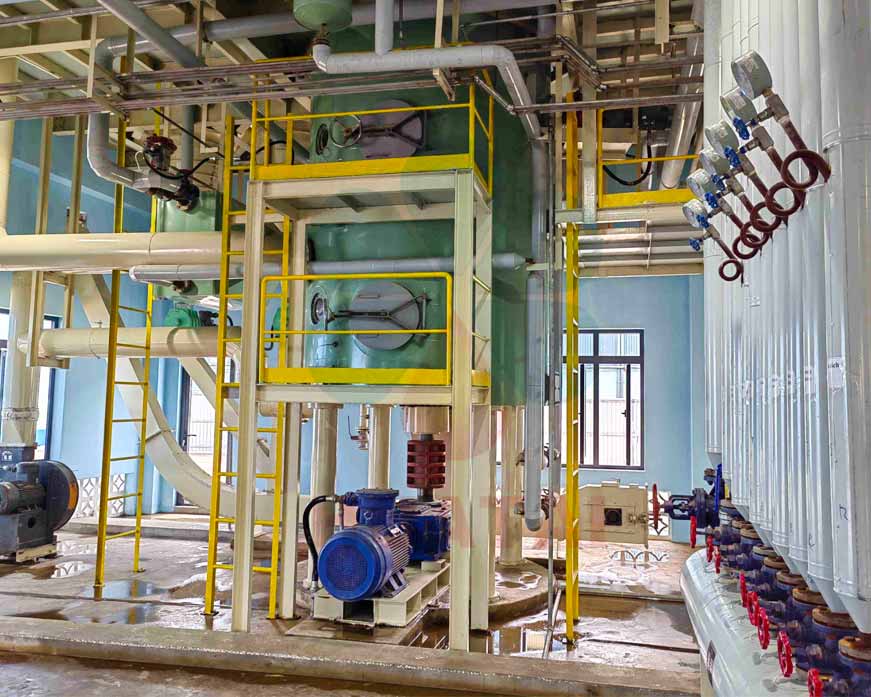
Rice bran oil—also known as rice oil—is a high-quality vegetable oil extracted from rice bran, a byproduct of rice processing. Rich in nutrients such as gamma-oryzanol, phytosterols, and Vitamin E, it is acclaimed as a “nutritious, healthy edible oil.” As consumer demand for healthy oils continues to rise, the rice bran oil processing industry faces significant growth opportunities.
However, for enterprises planning to invest in rice bran oil processing, the core question is: should one choose the pressing process or the solvent extraction process? These two processes differ significantly in terms of equipment configuration, investment scale, oil yield, and product positioning—factors that directly determine the project’s success. As an industry benchmark with over 38 years of experience in grain and oil machinery, Henan Huatai Cereals & Oils Machinery Co., Ltd. leverages its comprehensive product line and extensive project expertise to provide professional equipment selection services to global clients. This article systematically compares the two process routes to offer a scientific reference for your selection.
Huatai Oil Machinery: A Leader in Rice Bran Oil Processing Equipment
Henan Huatai Cereals & Oils Machinery Co., Ltd. covers an area of 100,000 square meters, operates 12 modern intelligent equipment manufacturing workshops, and maintains a business network spanning over 70 countries and regions. Recognized as a national-level “Green Factory,” Huatai Oil Machinery has established a complete product line covering the entire process: oilseed pretreatment, pressing, solvent extraction, and refining.
Characteristics and Processing Challenges of Rice Bran Oil
Before comparing the two processes in depth, it is essential to understand the unique characteristics of rice bran as a raw material. Rice bran has an oil content of approximately 18%–22% but is prone to rapid rancidity and exists in a fine, powdery form. It contains active lipases that quickly break down the oil during storage, leading to an increase in acid value. Furthermore, its powdery nature presents challenges for direct pressing or solvent extraction.
Therefore, regardless of the chosen process route, the pretreatment stage is crucial. To address the specific characteristics of rice bran, Huatai Oil Machinery employs an expansion process during the pretreatment stage. Through instantaneous high-temperature and high-pressure treatment, the process effectively inactivates the lipases within the rice bran, thereby extending its storage life. Simultaneously, it transforms the powdery rice bran into a porous, columnar structure, significantly enhancing the efficiency of subsequent oil extraction.
Detailed Overview of the Palm Oil Pressing Process and Equipment
1) Process Principle
The pressing method is a mechanical oil extraction technique that relies on external mechanical force to squeeze oil out of the rice bran. The entire process involves no chemical solvents and is purely physical in nature.
2) Core Equipment Configuration
The core equipment for a rice bran oil pressing production line includes:
Pretreatment equipment: Cleaning screens, destoners, magnetic separators, crushers, softening pot, flaking mills, and conditioning cookers (used for cleaning, crushing, and conditioning the rice bran).
Core oil press equipment: Screw oil press (utilizes a screw shaft within the press chamber to generate high pressure and squeeze out the oil).
Filtration equipment: Plate-and-frame filter presses (used for the preliminary purification of the crude oil obtained from pressing).
3) Advantages
Simple process: The equipment structure is relatively simple, making operation and maintenance straightforward.
Low investment: The initial investment required for equipment is low, making it suitable for small-to-medium-scale investors with limited capital.
Natural product: No chemical additives are used; the oil retains its nutritional components intact and possesses a pure flavor.
4) Limitations
Low oil yield: High residual oil content in the press cake (typically 7%–8%).
Low processing capacity: Limited capacity per unit; unsuitable for large-scale industrial production.
Low raw material utilization: Oil within the rice bran cannot be fully extracted, resulting in significant resource waste.
5) Suitable Scenarios
The pressing process is suitable for small production lines (daily processing capacity under 5 tons), premium oil production, or scenarios requiring a specific natural flavor profile in the oil.
Detailed Overview of the Rice Bran Oil Solvent Extraction Process and Equipment
1) Process Principle
Solvent extraction is a chemical oil extraction method that utilizes food-grade organic solvents (such as n-hexane) to dissolve the oil from the rice bran, followed by processes like evaporation to separate the solvent from the oil. Solvent extraction is currently the mainstream process for rice bran oil production, both domestically and internationally.
2) Core Equipment Configuration
The core equipment for a rice bran oil solvent extraction line includes:
Pre-treatment equipment: Similar to the pressing method, but with stricter requirements for steaming and roasting to ensure the rice bran reaches the optimal moisture content and temperature for extraction; additionally, an expander is required to alter the physical structure of the rice bran through high-temperature, high-pressure, instantaneous treatment.
Core oil solvent extraction equipment: Extractor (common types include rotary, loop, or drag-chain extractors); inside the extractor, rice bran comes into counter-current contact with the solvent, dissolving the oil into the solvent to form a mixture of oil and solvent (miscella).
Evaporation system: Evaporators, stripping towers, etc., used to separate the solvent from the oil mixture and recover the solvent.
Wet meal desolventizing system: Processes the extracted rice bran meal to recover residual solvent.
3) Advantages
High oil yield: Low residual oil content in the meal (consistently controllable below 0.5%), with an oil extraction rate exceeding 95%.
High processing capacity: Suitable for large-scale, continuous industrial production.
Low comprehensive cost: Although equipment investment is high, the processing cost per unit of product is lower.
High resource utilization: Oilseed resources are fully utilized.
4) Limitations
Complex equipment: The system involves a wide variety of equipment with complex structures, resulting in a high investment threshold.
High investment: Initial equipment costs are significantly higher than those of the pressing process.
High technical requirements: Demands higher technical proficiency and safety management standards from operators.
5) Suitable Scenarios
The extraction process is suitable for industrial production at a medium scale or larger (daily processing capacity of 5 tons or more) and is currently the mainstream choice for rice bran oil processing.
5. Comprehensive Comparison of Pressing and Solvent Extraction Processes
| Comparison Dimension | Pressing Process | Solvent Extraction Process |
| Process Nature | Physical/mechanical pressing | Chemical solvent extraction |
| Core Equipment | Screw oil press | Extractor + evaporation system |
| Equipment Complexity | Simple | Complex |
| Investment Scale | Small | Large |
| Oil Yield | Low (residual oil 7%–8%) | High (residual oil <0.5%) |
| Processing Capacity | Small (<5 tons/day) | Large (5–200+ tons/day) |
| Product Characteristics | Rich flavor, good nutrient retention | Colorless and odorless, retains compounds like gamma-oryzanol |
| Applicable Scale | Small-scale, premium oil production | Medium-to-large scale industrial production |
| Refining Requirement | Requires refining | Requires refining |
Crude oil produced by either process requires refining to meet edible oil standards. The equipment configuration for the refining stage is essentially the same for both, requiring degumming tanks, deacidification tanks, bleaching towers, deodorization towers, etc.
Five Key Factors for Scientific Selection
1) Production Capacity Scale
This is the most critical decision-making factor. For a daily processing capacity of less than 5 tons, the pressing process may be considered; for capacities exceeding 5 tons, the solvent extraction process is recommended.
2) Investment Budget
The investment threshold for pressing equipment is low, making it suitable for projects with limited capital; while the solvent extraction process requires a higher initial investment, it offers superior comprehensive economic benefits during long-term operation.
3) Product Positioning
If the product is positioned as high-end, premium rice bran oil—emphasizing “physical pressing” and “natural health”—the pressing process offers a distinct competitive advantage. If positioned as a mass-market cooking oil—prioritizing economies of scale and cost efficiency—solvent extraction is the better choice.
4) Raw Material Supply
The stability of the rice bran supply must be considered. Solvent extraction requires continuous production, placing higher demands on the stability and scale of the raw material supply.
5) Technical Expertise
Solvent extraction places higher demands on operator skill levels and safety management; the capabilities of your own technical team should be evaluated accordingly.
Advantages of Huatai Oil Machinery’s Rice Bran Oil Processing Equipment
1) End-to-End Solutions
Huatai Oil Machinery provides equipment and technical services covering the entire process, from raw material pretreatment, expansion (extrusion), and extraction/pressing to refining. The company offers comprehensive services—including process design, equipment selection, and installation and commissioning—tailored to the client’s raw material characteristics, production capacity requirements, and budget.
2) Advanced Expansion Technology
Huatai Oil Machinery’s core expansion process utilizes high-temperature, high-pressure instantaneous treatment to effectively deactivate lipases within the rice bran, thereby extending shelf life. Simultaneously, it transforms powdered rice bran into a porous, columnar structure, significantly enhancing solvent permeability.
3) Intelligent Control Systems
Huatai Oil Machinery’s rice bran processing equipment integrates intelligent control systems, enabling automated operation across the entire process—from raw material pretreatment to extraction—thereby substantially reducing labor and energy costs.
4) Global Project Experience
Huatai Oil Machinery’s rice bran oil processing equipment has been exported to 70 countries and regions worldwide. Representative cases include:
Iran 30 T/D rice bran oil extraction equipment: Purchased by a returning client; utilizes an advanced drag-chain extractor, effectively reducing consumption metrics.
Vietnam 200 T/D rice bran expansion and extraction plant: Designed for the hot and humid climate of Southeast Asia; the extraction workshop employs refrigeration-based absorption technology, reducing solvent consumption by 20%.
100 T/D rice bran expansion and extraction project in Heilongjiang Province: An integrated project combining pretreatment, expansion, and extraction processes.
Conclusions and Recommendations
Rice bran oil processing has evolved into two distinct technical systems regarding equipment selection: the pressing method and the solvent extraction method. Pressing involves simpler equipment and lower investment, making it suitable for small-to-medium-scale production or scenarios where specific oil flavor profiles are required. Solvent extraction involves complex equipment and higher initial investment but offers high oil yields, large processing capacities, and lower comprehensive costs, making it ideal for large-scale industrial production.
Selection Recommendations:
Small-scale projects (<5 tons/day): The pressing process is a viable option, with equipment configurations centered around screw oil presses.
Medium-to-large-scale projects (≥5 tons/day): The solvent extraction process is recommended, with equipment configurations centered around an expander, an extractor, and an evaporation system.
Regardless of the process chosen, the pretreatment stage (especially expansion) cannot be overlooked, as it directly impacts oil yield and product quality.
As a leading enterprise in the rice bran oil processing equipment sector, Henan Huatai Cereals & Oils Machinery Co., Ltd. leverages over 38 years of technical expertise, a comprehensive product line covering the entire process, and extensive global project experience to provide one-stop turnkey services—ranging from process design and equipment selection to installation and commissioning. If you require a complete rice bran oil processing line, please contact us for a professional, customized solution.
Website: https://ricebranoilpress.com/
Email: info06@cnoilmachine.com