
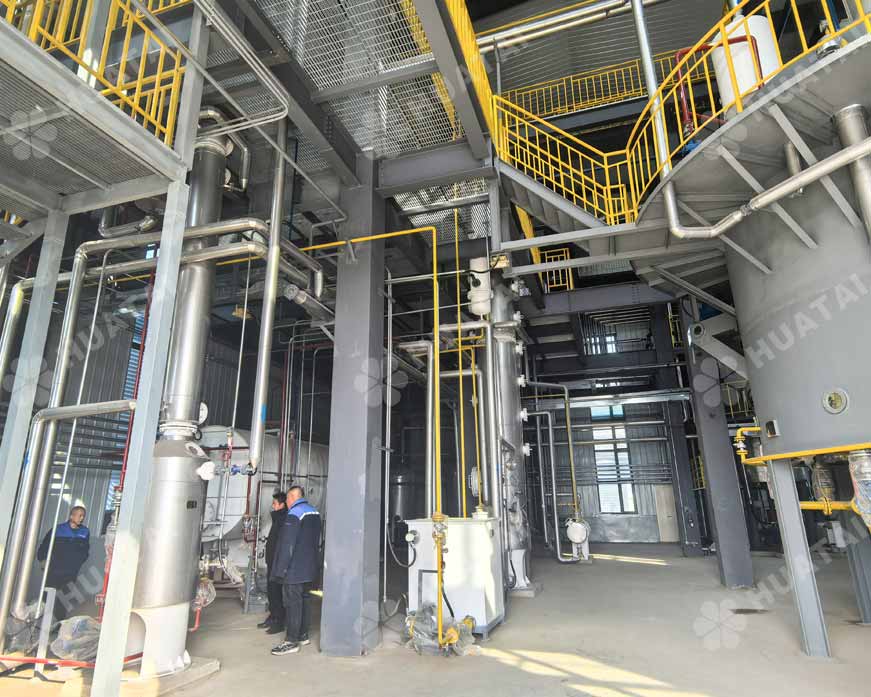
Rice bran oil is increasingly favored by the market due to its nutritional value and health benefits, and choosing efficient and reliable rice bran oil production equipment is crucial for a company’s success. Henan Huatai Cereals and Oils Machinery Co., Ltd., a leading enterprise in China’s grain and oil machinery industry with over 37 years of professional experience, will provide you with a comprehensive purchasing guide based on Huatai Oil Machinery’s technological advantages.
-
Understanding the Key Process Steps of Rice Bran Oil Production
Before choosing rice bran oil equipment, you must first understand the complete rice bran oil production process:
Pre-treatment section: Rice bran cleaning, magnetic separation, softening, and extrusion
Extraction section: Solvent extraction, wet meal desolventization, mixed oil evaporation, solvent recovery
Refining section: Degumming, deacidification, decolorization, deodorization, dewaxing
Finished product treatment section: Winterization, filtration, packaging
The equipment selection at each stage directly affects the final oil quality and production efficiency.
-
Eight Key Factors in Choosing Rice Bran Oil Production Equipment
1) Maturity and Innovation of Rice Bran Oil Equipment Technology
Henan Huatai Cereals and Oils Machinery Co., Ltd. adopts the internationally advanced “rice bran extrusion and extraction” technology, which offers the following advantages compared to traditional processes:
Increased oil yield by 1.5-2%
Reduced energy consumption by 15-20%
Reduced solvent consumption by 30%
Significantly lower oil acid value
When purchasing, you should focus on whether the rice bran oil equipment supplier has continuous innovation capabilities and patented technologies.
2) Rice Bran Oil Equipment Materials and Manufacturing Standards
High-quality rice bran oil production equipment must meet food-grade requirements:
Parts in contact with materials: All made of 304 or 316L stainless steel
Pressure vessels: Possess manufacturing licenses issued by the State Administration for Market Regulation
Welding process: Automatic argon arc welding, smooth welds without dead corners
Surface treatment: Matte finish, easy to clean and maintain
All Huatai Oil Machinery equipment complies with the ISO9001 quality management system and has passed CE certification.
3) Energy Efficiency and Environmental Performance
Modern rice bran oil equipment must have:
Heat recovery system: such as Huatai’s DTDC desolventizer heat recovery technology
Solvent recovery rate: ≥99.5%, reducing production costs
Wastewater discharge: compliant with national emission standards
Noise control: main rice bran oil equipment noise ≤85 decibels
4) Automation and Intelligence Level
Intelligent rice bran oil production lines should have:
PLC automatic control system
Online monitoring of key process parameters
Automatic fault diagnosis and alarm function
Production data traceability system
Huatai Oil Machinery’s “Intelligent Grain and Oil Factory Solution” can achieve full-line automation control, reducing manual intervention.
5) Rice Bran Oil Production Scale and Equipment Configuration Matching
Choose reasonably based on your investment budget and market demand:
| Production Scale | Daily Processing Capacity | Recommended Configuration | Suitable Enterprise Type |
| Small | 20-50 tons | Semi-continuous refining | Local oil mills |
| Medium | 50-200 tons | Continuous extraction + refining | Regional brand enterprises |
| Large | 200-500 tons | Fully automatic continuous production line | Large oil and fat groups |
| Extra Large | 500 tons and above | Customized integrated system | International enterprises |
6) Supplier’s Comprehensive Service Capabilities
When choosing a rice bran oil equipment supplier, consider:
R&D capabilities: whether there is a professional R&D team and laboratory
Manufacturing strength: scale of production base and equipment precision
Installation and commissioning: whether professional installation guidance is provided
Training services: whether operation and maintenance training is comprehensive
After-sales support: response speed and spare parts supply capacity
Huatai Oil Machinery has multiple service centers in China and abroad, providing 48-hour technical support.
7) Return on Investment Analysis
Consider the following economic factors:
Initial investment: equipment purchase cost
Operating costs: energy consumption, labor, maintenance costs
Product yield: directly determines profitability
Equipment life: generally, high-quality equipment has a service life of 15-20 years
Investment payback period: usually 2-4 years
8) Success Stories and Market Reputation
Examine the supplier’s customer cases:
Successful experience in similar rice bran oil projects
Customer feedback and evaluation
Long-term operational stability of the rice bran oil equipment
Whether there is cooperation with well-known enterprises
Huatai Oil Machinery has provided more than 1000 sets of grain and oil equipment to customers in more than 60 countries, including well-known enterprises such as COFCO and Yihai Kerry.
-
Unique Advantages of Huatai Oil Machinery Rice Bran Oil Equipment
1) Technical Highlights
Rice Bran Stabilization Technology: Effectively inhibits lipase activity, reducing the rate of acid value increase by 80%.
Low-Temperature Deodorization Process: Protects nutrients such as gamma-oryzanol, with a retention rate of >85%.
High-Efficiency Dewaxing System: Adopts integrated crystallization and crystal growth technology, with a dewaxing efficiency of >95%.
Modular Design: Can be flexibly combined according to customer needs, facilitating future expansion.
2) Energy-Saving Features
Uses mechanical vapor recompression technology, saving 40% on energy.
Optimized heat exchange network design, reducing overall energy consumption by 25%.
Exhaust gas waste heat recovery system, achieving a thermal energy utilization rate of 90%.
-
Recommended Purchasing Process
Phase One: Needs Analysis (1-2 weeks)
Clarify market positioning and product standards
Determine investment budget and production scale
Collect preliminary information from multiple rice bran oil equipment suppliers
Phase Two: Supplier Evaluation (2-3 weeks)
On-site visit to the rice bran oil manufacturing plant
Inspect currently operating rice bran oil production lines
In-depth communication with the technical team
Review qualifications and certification documents
Phase Three: Solution Evaluation (1-2 weeks)
Compare technical solutions and process flows
Analyze return on investment and operating costs
Evaluate after-sales service and support system
Phase Four: Contracting and Implementation (3-6 months)
Signing of detailed technical agreements and contracts
Supervision of the manufacturing process and key milestones
Participation in installation, commissioning, and personnel training
Acceptance testing and performance evaluation
-
Common Misconceptions and Avoidance Methods
Misconception: Focusing solely on price, neglecting long-term operating costs
Suggestion: Use a total life cycle cost analysis method, considering the total cost over 10 years
Misconception: Over-pursuing automation, neglecting practicality
Suggestion: Choose the level of automation based on actual management level and maintenance capabilities
Misconception: Ignoring differences in local raw material characteristics
Suggestion: Provide raw material samples for pilot testing to ensure equipment suitability
Misconception: Underestimating the importance of installation, commissioning, and training
Suggestion: Include installation guidance and training in the contract terms to ensure effective implementation
-
Future Trends and Sustainable Development
With the development of the industry, rice bran oil equipment is developing in the following directions:
Green and energy-saving: Energy consumption and emission standards are constantly improving
Smart IoT: Remote monitoring and predictive maintenance are becoming standard features
Flexible production: Ability to flexibly adjust production of different grades of products
Enhanced safety: Stricter requirements for explosion protection and safe production
When choosing rice bran oil equipment, consider the technological development trends of the next 5-10 years to ensure that the investment is forward-looking.
Conclusion
Choosing rice bran oil production equipment is a comprehensive investment decision that requires balancing technological advancement, economic rationality, and operational reliability. Henan Huatai Cereals and Oils Machinery Co., Ltd., with over 37 years of professional experience, not only provides high-quality rice bran oil equipment but also offers comprehensive solutions from planning and design to installation and training. Buyers are advised to fully communicate their needs, conduct on-site inspections, and choose the partner best suited to their development before making a decision.
Website: https://ricebranoilpress.com/
Email: info06@cnoilmachine.com