
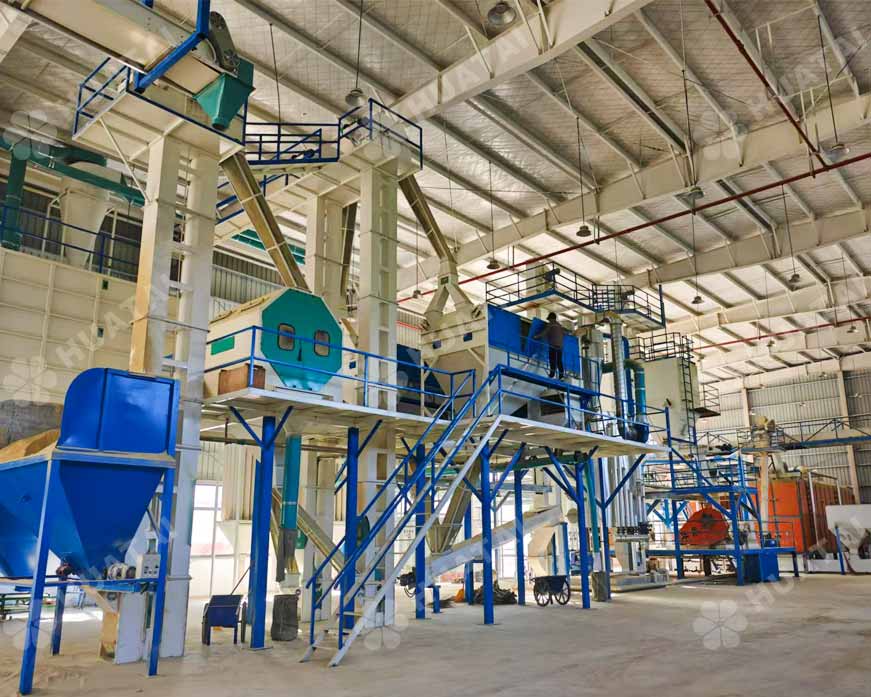
In any investment project involving rice bran oil, the configuration of the production line is a critical factor that directly influences oil yield, product quality, energy consumption, and long-term operational costs. Compared to other oil-bearing raw materials, rice bran presents unique challenges: it typically contains 15%–20% oil, but also possesses high lipase activity. If not processed promptly, the oil undergoes hydrolytic rancidity, leading to an increase in acid value and a decline in quality. Consequently, designing an effective rice bran oil production line cannot simply rely on standard edible oil processing models; instead, it requires a systematic approach centered on “timely processing, stable solvent extraction, moderate refining, and quality control.”
Henan Huatai Cereals and Oils Machinery Co., Ltd. has long specialized in oil processing machinery and engineering services, accumulating extensive expertise in the pretreatment, solvent extraction, and refining of rice bran oil, as well as the configuration of complete production systems. For a rice bran oil project, an optimal production line configuration must account for factors such as raw material freshness, daily processing capacity, product positioning, investment budget, and local environmental regulations—culminating in a comprehensive process design that spans from raw material intake to the storage of the finished oil.
-
Why Is a “Well-Configured” Production Line Essential for Rice Bran Oil?
The primary objective of a rice bran oil production line is to extract the maximum amount of oil from the rice bran while keeping costs under control, and subsequently refining it into a finished product that meets market demands. However, rice bran as a raw material has three distinct characteristics:
1) Susceptibility to Rancidity: The lipase present in rice bran rapidly hydrolyzes the oil, causing a rise in free fatty acids. The longer the raw material is stored, the greater the burden on the subsequent refining process.
2) High Wax Content: Rice bran oil naturally contains waxes. If the refining configuration is inadequate, the finished oil may appear cloudy or exhibit poor stability at low temperatures.
3) High Value of By-products: Rice bran oil contains beneficial components such as oryzanol, phytosterols, and vitamin E. The rice bran oil refining process must balance the need for high-quality oil with the goal of minimizing the loss of these valuable compounds through over-processing.
Therefore, the ideal rice bran oil production line is not necessarily the one with the most equipment, nor the one with the least; rather, it is one that is precisely tailored to the specific raw materials and the intended product positioning. A well-designed configuration should ensure: timely and effective pretreatment, a stable and efficient extraction system, a well-regulated and controlled refining process, and a proper balance between automation and manual operation.
-
Rational Process Configuration for Rice Bran Oil Production Lines
A comprehensive rice bran oil production line typically encompasses pretreatment, extraction, refining, and finished product storage. Equipment can be adjusted based on specific production capacity requirements and desired product grades.
1) Rice Bran Pretreatment Section
Pretreatment is the critical first stage in rice bran oil production. It is recommended to include equipment for cleaning and impurity removal, magnetic separation, conditioning, expansion (extrusion), as well as drying and cooling. Cleaning removes foreign matter such as broken rice, stones, and metal, while conditioning and expansion improve the permeability of the rice bran and inhibit certain enzymatic activities, thereby creating stable conditions for the subsequent extraction process.
For rice bran oil projects, the time elapsed between the rice milling facility and the rice bran oil mill should be minimized. Furthermore, appropriate preservation or conditioning measures should be implemented based on the specific characteristics of the raw material. When designing project solutions, Huatai Oil Machinery typically tailors the pretreatment equipment to the raw material source, transport radius, and daily processing capacity, ensuring that instability in the initial processing stages does not compromise extraction efficiency or crude oil quality.
2) Extraction Section
The extraction process is commonly employed in rice bran oil production to maximize oil yield. This section typically includes an extractor, a mixed-oil evaporation system, a stripping tower, a desolventizing system for the wet meal, and a solvent recovery system. Equipment selection should prioritize sealing integrity, solvent consumption, energy efficiency, and operational continuity.
A well-configured extraction section requires an extractor of appropriate capacity, supported by robust solvent recovery and exhaust gas treatment systems. For small-to-medium-scale projects, configurations that are easy to operate and maintain—with manageable investment costs—are often preferred. For larger-scale projects, greater emphasis should be placed on automated control, stable continuous operation, and energy-efficient design.
3) Refining Section
The refining of rice bran oil generally involves degumming, deacidification, bleaching (decolorization), deodorization, and dewaxing/winterization. The specific configuration should be determined based on the crude oil’s acid value, color, wax content, and the required standards for the finished oil.
Degumming: Removes phospholipids and other gum-like impurities, preparing the oil for subsequent refining stages.
Deacidification: Lowers the free fatty acid content; the method—such as alkali refining or physical refining—is selected based on the oil’s initial acid value.
Bleaching: Improves the oil’s color through adsorption using bleaching earth (clay), while carefully controlling operating conditions to minimize oil loss.
Deodorization: Removes odor-causing substances under high-temperature and high-vacuum conditions to enhance the flavor profile of the finished oil.
Dewaxing/Winterization: Specifically addresses the high wax content in rice bran oil, improving the low-temperature stability and visual appearance of the final product.
Huatai Oil Machinery can provide customized rice bran oil refining equipment configurations tailored to specific project requirements, balancing quality standards with oil yield and operational costs. For premium-positioned rice bran oil products, the configuration can incorporate “moderate refining” principles to avoid unnecessary, excessive processing.
-
Key Control Points for High-Quality Rice Bran Oil
While a well-configured production line is the foundation, consistently producing high-quality oil requires strict control over the following key areas:
1) Raw Material Freshness: Minimize the storage duration of rice bran and establish a rapid turnover mechanism for raw materials.
2) Pretreatment Stability: Regulate conditioning temperature, moisture content, and expansion (extrusion) effects to ensure a stable structure for the material entering the extraction process.
3) Extraction System Sealing and Solvent Recovery: Reduce solvent consumption and strictly control residual solvent levels in the crude oil.
4) Refining Parameter Control: Adjust degumming, deacidification, bleaching, and deodorization parameters based on the specific characteristics of the crude oil to prevent over-refining.
5) Dewaxing and Winterization Efficacy: Monitor the oil’s performance during low-temperature storage to ensure consistent visual quality.
6) Testing and Traceability: Implement routine testing for parameters such as acid value, peroxide value, color, and moisture/volatile content, and maintain detailed quality records for each batch.
-
Engineering Service Advantages from Huatai Oil Machinery
Henan Huatai Cereals & Oils Machinery Co., Ltd. offers comprehensive services for rice bran oil projects, ranging from process design and equipment manufacturing to installation, commissioning, operational training, and ongoing after-sales support. When it comes to the configuration of rice bran oil production lines, Huatai Oil Machinery typically assists clients in the following areas:
1) Determining equipment specifications for the pretreatment, extraction, and refining sections based on raw material characteristics and target production capacity;
2) Designing an appropriate level of refining and a dewaxing strategy tailored to the client’s product positioning;
3) Optimizing equipment layout according to facility conditions, ensuring both operational convenience and ease of future maintenance;
4) Enhancing operational stability and reducing manual labor intensity through automated control systems;
5) Providing training for operators during the installation and commissioning phases to help the project reach a stable production state as quickly as possible.
For investors, selecting rice bran oil processing equipment should not be based solely on the price of individual machines; rather, it requires careful consideration of the integration of the entire rice bran oil production line, energy consumption, maintenance costs, and after-sales support. A well-configured production line lowers overall costs over the long term and ensures the consistent production of high-quality oil.
Conclusion
A properly configured rice bran oil production line is the foundation for producing high-quality rice bran oil. Given that rice bran is prone to rancidity and has a high wax content, the design of the production line must account for these raw material characteristics, integrating pretreatment, extraction, refining, and quality control. Henan Huatai Cereals & Oils Machinery Co., Ltd. offers customized equipment configuration and engineering support tailored to the specific needs of each project, helping enterprises control investment and operating costs while reliably producing oil products that meet market demand.
Website: https://ricebranoilpress.com/
Email: info06@cnoilmachine.com